Repo review · Tested August 10, 2026
The internet has no agent API. Agent-Reach maintains the workaround.
Agent-Reach routes coding agents' web and social research across 15 platforms, choosing the specialized CLI, API, or browser session each job needs.

Web and social research for a coding agent is not one integration. It is a pile of GitHub credentials, browser cookies, RSS feeds, rate limits, command-line tools, and social platforms that all chose a different secret handshake. An agent can refactor a codebase before lunch, then lose the afternoon figuring out which tool can read one Instagram profile.
Agent-Reach maintains the map through that pile. It tells coding agents which upstream tool currently handles each of 15 platforms, installs or diagnoses the route, and supplies commands and fallbacks. The project owns the directions; specialized CLIs, APIs, and logged-in browser sessions still own the roads.
Tested: commit
1221ecd0c3e0502ee37406f03543bedf7503f2c7on August 10, 2026. Scope: read-only X and Instagram research through OpenCLI, checked against visible public pages. Result: X search worked and one result matched the visible post; Instagram search worked, but profile and recent-post reads failed with login errors, and the cause is unresolved. Verdict: adopt with care for a local research workstation, not unattended production ingestion.
Set up Agent-Reach with your coding agent
Paste this prompt into Claude Code, or another coding agent that can run commands, to install the latest Agent-Reach from GitHub. It asks before it changes your system.
Set up Agent-Reach (https://github.com/Panniantong/Agent-Reach) on this computer so you can read Reddit, X and YouTube links. Go one step at a time.

1. Install the latest version from GitHub with pipx. Do not use `pip install agent-reach`: that PyPI name is a different project.
   pipx install https://github.com/Panniantong/Agent-Reach/archive/main.zip
   Run `agent-reach --version`. It should print "Agent Reach v1.5.0" or newer. Stop if it prints anything else.
2. Preview only: run `agent-reach install --env=auto --dry-run --channels=opencli` and show me the output.
3. Tell me what the next step will install, then wait for my yes. After I agree, run:
   AGENT_REACH_LANG=en agent-reach install --env=auto --system --channels=opencli
   Ask again before installing anything else. Never use sudo.
4. I will add the OpenCLI extension to Chrome and log in to Reddit and X myself, with a second account. Stop and wait for me. Never export, read or ask me for cookies or passwords.
5. `agent-reach doctor` cannot confirm logins. Open the installed skill's SKILL.md and use its commands to read one Reddit thread, run one X search, and fetch one YouTube video's subtitles. Show me the first lines of each.
6. Report every tool, config file and skill folder you installed or changed, what worked, and what failed. Do not retry a failure more than once without asking.
Web and social research for AI agents is a routing problem
The project calls itself a capability layer. In practice, it is a curated package list, installer, health check, and instruction manual for an AI agent.
At the revision we tested, its routing table covered 15 destinations, including ordinary web pages, GitHub, YouTube, RSS, X, Reddit, Instagram, Facebook, Bilibili, Xiaohongshu, and LinkedIn. The routes are intentionally uneven. GitHub uses the official gh CLI. YouTube uses yt-dlp. Web pages go through Jina Reader. Several authenticated social networks use OpenCLI and an existing browser session.
Agent-Reach does not squeeze those tools into a fake universal API. Its installed skill teaches the agent which one to call and what fallback to try. If a backend stops working, maintainers can change the preferred route instead of rebuilding the whole product. That is a sensible response to a category where the doors move.
Fifteen platforms, several actual tools
Agent-Reach’s history begins in February 2026, and the Python package still labels itself Beta. By August 11, GitHub reported 70,361 stars and 5,949 forks, remarkable numbers for a project less than six months old. Stars remain applause, not a warranty card.
The release history is more useful than the star count. Seven named releases arrived between late February and June, and Instagram was added, removed, then returned through a different backend. Version 1.5.0, published in June, describes the move to the current multi-backend design. The map stays useful only while somebody keeps redrawing it.
The simplest channels ask for little ceremony: for some sources, a URL and an unauthenticated reader are the whole trip. The repository also ships a module for every one of its 15 channels, which establishes the breadth of the ambition rather than 15 verified live routes.
Authenticated platforms ask more of the operator. You need a compatible local runtime, the selected CLIs, a browser extension in some cases, and a logged-in account. The project’s own installation guide recommends dedicated accounts because browser-session automation can expose credentials or attract platform enforcement. That warning is worth taking literally.
The payoff is conversational research. Instead of explaining how to authenticate a new X library, you ask for X research and let the skill select a route. The output still comes from the underlying CLI, so existing agent tooling can inspect the JSON, compare sources, and continue working.
X and Instagram took different exits
We used a dedicated account in a headed browser session on one disposable Linux desktop. Agent-Reach selected the routes, OpenCLI executed the commands, and GitTested checked the returned records against the visible pages. The results establish those routes on that revision, not every route on every machine.
The X route did what we wanted. Asked to search for “Agent Reach,” it returned five structured posts. We independently opened one of the five and matched its ID and URL, author, and opening text to the command output.
Instagram was mixed. User search worked and returned the verified GitHub account first. Profile and recent-post reads then returned an HTTP 400 claiming the session was not logged in, even while the browser displayed the requested profile:
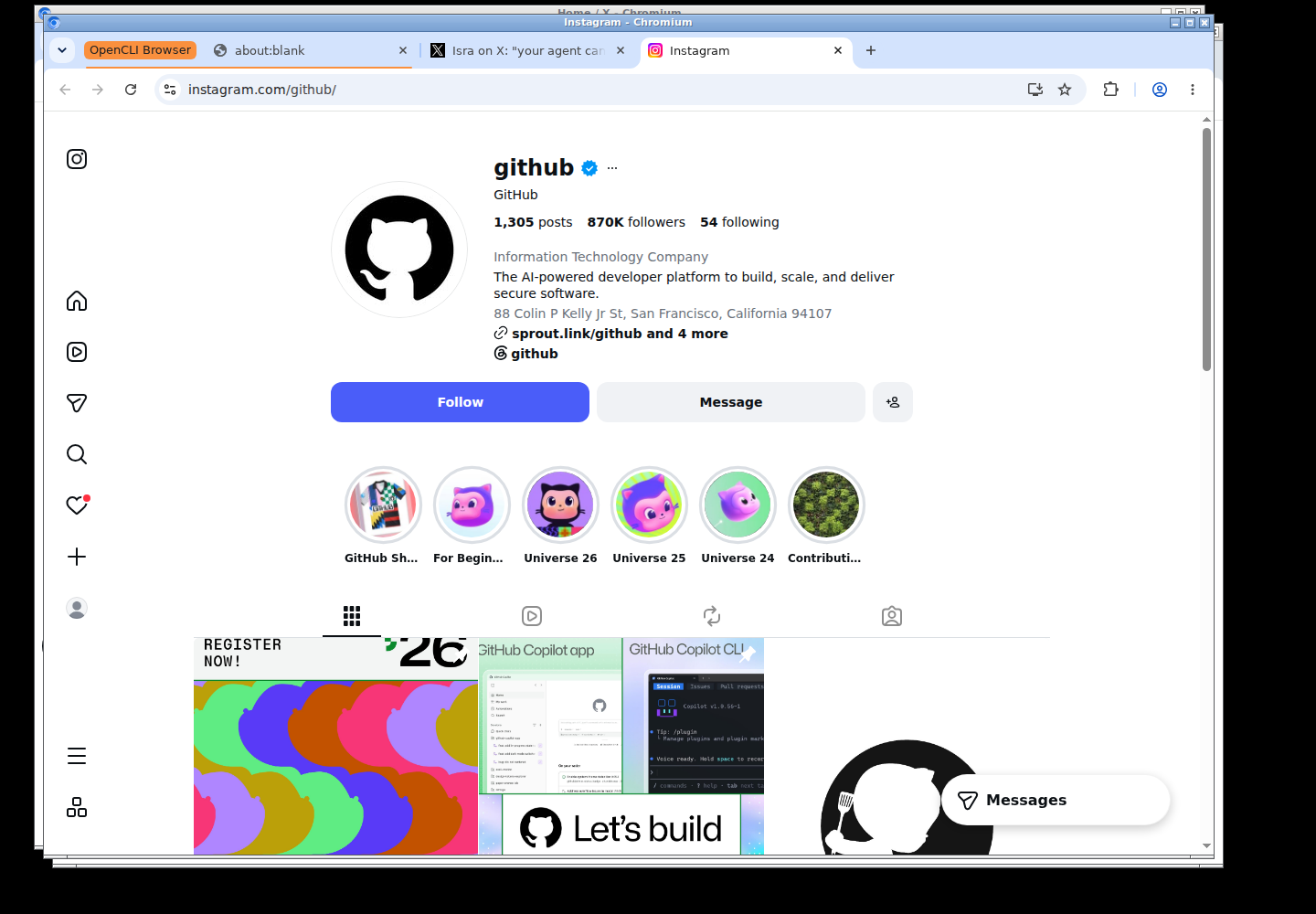
The screenshot shows the contradiction plainly: the browser could see the profile that the command insisted required a login. Open issue #550 records a similar search-works, profile-fails split on Windows with the same OpenCLI version. One report does not establish prevalence, but it does suggest more than one machine having a bad morning. We could not resolve the cause; the candidates include Instagram, OpenCLI, its adapter and session state, and upstream change, and none of them confessed.
Setup stayed a job of its own. The pinned package installed cleanly, but the broad system installer ended incomplete during unrelated package-manager work and reported 5 of 15 channels active. That failure belonged to the environment rather than Agent-Reach; the coupling is still the point. A tool that assembles other tools inherits the days when the other tools will not be assembled.
The price of owning the map
Agent-Reach removes research about tools; it does not remove ownership of tools.
Its doctor command can identify installed backends and offer repair advice. In our run, a healthy check meant the browser bridge was awake, not that the next command would succeed. An operator still wants a cheap read-only probe before trusting a route. One independent Windows report described route drift and diagnostic ambiguity, and a maintainer landed selected fixes before the revision we tested.
You gain one maintained place for backend choices, safety notes, and fallbacks. You still inherit browsers, cookies, extensions, CLIs, public endpoints, and social platforms that occasionally replace the carpet while everybody is standing on it.
For a local coding agent that researches several platforms, that bargain can be good. Agent-Reach makes sense for exploratory research, support investigation, trend monitoring, and content discovery when a technically capable person can repair an occasional backend. It is social media for AI agents in the read-and-research sense, not a publishing scheduler.
If you need only GitHub and YouTube, installing gh and yt-dlp directly may be simpler. If you need stable production ingestion, one schema, audited credentials, or contractual reliability, consider official APIs or a hosted data provider. If you need custom multistep interaction on a small set of sites, a browser-automation stack you own may offer more control at the cost of more maintenance.
Agent-Reach is not the service behind those choices. It is the opinionated map between them.
A good research workstation, not invisible infrastructure
Adopt Agent-Reach with care on a local research workstation. Its abstraction fits the real problem: the internet is not one agent API, and pretending otherwise usually produces one very confident error message. Our X route showed that the routing layer can deliver useful, independently checkable research.
Use dedicated accounts and expect a capable operator to handle some plumbing. Agent-Reach can tell an agent which road to take. It cannot stop the road owner from moving the exit.