Repo review · Tested August 20, 2026
OpenCLI puts your logged-in web on the command line
OpenCLI is an open-source browser CLI that lets agents query and operate websites through a logged-in Chrome session. The reach is broad; the permission boundary is yours to enforce.

A website can expose an API, or it can expose the page a human already uses and wish your automation the best of luck. OpenCLI chooses the second door. It connects command-line instructions to a logged-in Chrome session, then turns browser actions and website-specific knowledge into commands an AI agent can call.
That is immediately useful. It also gives an agent broad access to your logged-in browser. Whether OpenCLI fits depends on how tightly you can limit its commands, sites, and supervision.
Tested: commit
50565efddebd171e064587d88a6a0277f570fdd0on August 20, 2026. Scope: a new read-only adapter for the live GitTested review archive, plus bounded X and Instagram reads through a dedicated browser profile. Result: the adapter passed two live verification runs; X returned visible records; Instagram search, profile, and recent-post reads worked. Verdict: adopt with care for supervised local research and custom read-only adapters.
Set up OpenCLI with your coding agent
Paste this prompt into Claude Code, or another coding agent that can run commands, to install the latest OpenCLI from npm. You add the browser extension and do every login yourself.
Set up OpenCLI (https://github.com/jackwener/OpenCLI) on this computer so you can run website commands through my Chrome browser. Go one step at a time.

1. Check `node --version` is 20.18.1 or newer. Install the latest version from npm; the package is `@jackwener/opencli`:
   npm install -g @jackwener/opencli
   Run `opencli --version`. It should print 1.8.8 or newer. Stop if it prints anything else. If the install needs sudo, stop and ask me.
2. Stop and wait for me. I will add the OpenCLI extension from the Chrome Web Store link in the README, in a separate Chrome profile, and log in to sites there myself with dedicated accounts. Never export, read or ask me for cookies or passwords.
3. After I say the extension is installed, run `opencli doctor`. Stop if it reports that the extension is not connected.
4. Run `opencli list` and tell me how many commands it shows. Then run `opencli hackernews top --limit 5` and show me the output.
5. Read only. Do not run a command that posts, replies, likes, follows, sends a message or downloads files unless I ask for that exact action.
6. Tell me the next step adds OpenCLI's skills to this project's skills folder, then wait for my yes. After I agree, run:
   npx skills add jackwener/opencli --skill opencli-usage opencli-browser --agent claude-code --yes
   For another agent, replace `claude-code` with its name.
7. Report what you installed or changed and what failed. Do not retry a failure more than once without asking.
A browser CLI in three layers
OpenCLI has three useful layers. The first is generic browser control: open a page, inspect state, find elements, click, type, take screenshots, and trace a run. The second is a catalog of site adapters that package common jobs into commands. The pinned CLI listed 166 adapters, which establishes an ambitious catalog, not 166 guarantees.
The third layer is adapter authoring. OpenCLI can analyze a page, create a scaffold, run the adapter against a live browser, record a fixture, and verify the output contract. This is the part that makes it more than a shell-shaped wrapper around Chrome.
It also explains the relationship to Agent-Reach. Agent-Reach is the routing layer: it chooses and installs different backends for different research destinations. OpenCLI is one of those backends, and the browser-backed engine underneath several authenticated social routes. If Agent-Reach is the map, OpenCLI is one particularly broad road system.
Use Agent-Reach when you want an agent to choose among research tools. Use OpenCLI when you want to build or operate the browser-backed commands themselves.
The project is young and very visible. GitHub reported 28,362 stars on August 20, five months after the repository was created. Releases 1.8.0 through 1.8.6 arrived between May and July. That is an activity signal, although stars remain applause rather than a service-level agreement.
The logged-in web answered back
We tested OpenCLI on an Ubuntu desktop. The source-built CLI identified itself as OpenCLI 1.8.6 and connected to the pinned Browser Bridge extension, version 1.0.22.
On X, we deliberately skipped the packaged Twitter adapter. Generic browser commands opened an authenticated public search for opencli and selected the first three visible post elements. The CLI returned three inspectable records. That proved the basic bridge could operate a live, logged-in site without granting the adapter catalog credit it had not earned.
Instagram tested the packaged route. Account search returned GitHub first, followed by githubprojects and githubeducation. The profile command returned GitHub’s bio, 1,311 posts, 874,254 followers, and 54 following. The recent-post command returned three posts with captions and engagement fields. The visible profile showed the same identity, counts, and bio:
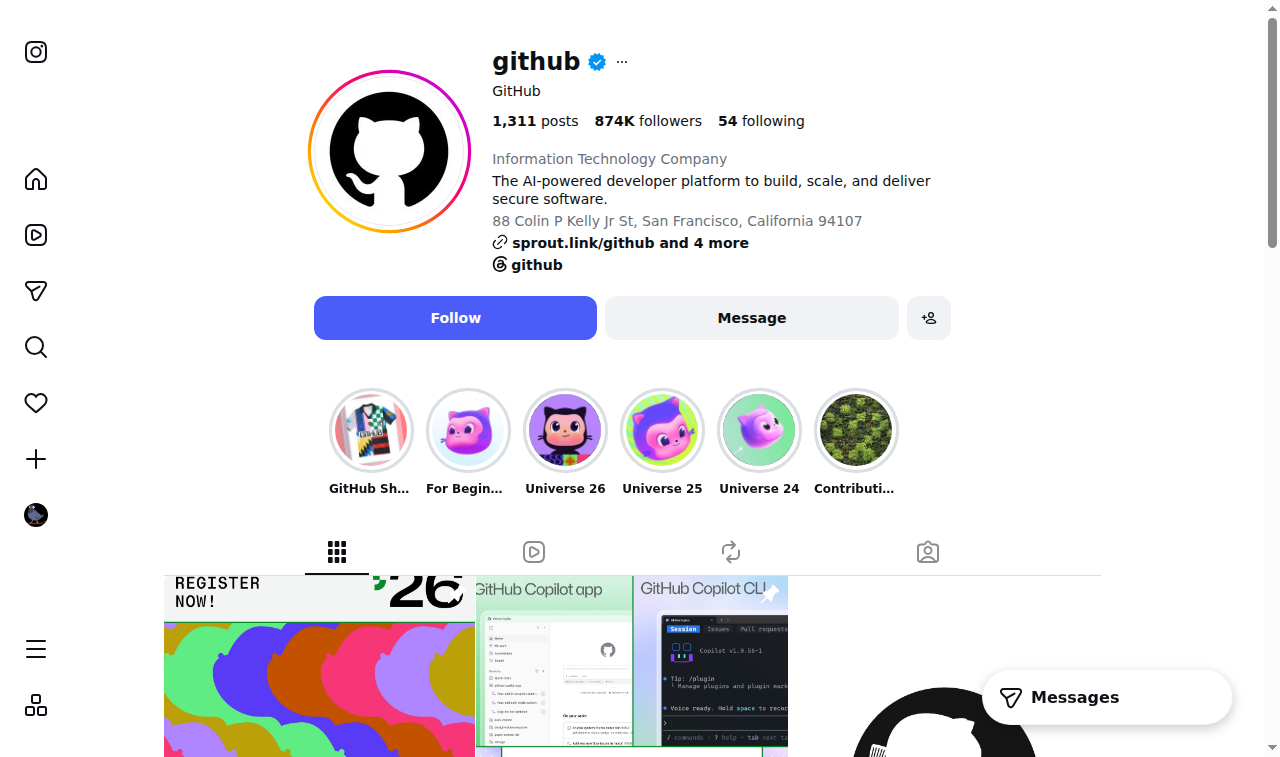
Our earlier Agent-Reach evaluation saw Instagram search succeed while profile and recent-post reads failed, despite reporting the same OpenCLI and extension versions. This run succeeded. It does not tell us what changed, and it would be tidy fiction to declare the earlier problem fixed.
The adapter was the real audition
Social adapters are vulnerable to platform changes, account state, and anti-automation systems. The more revealing test was whether OpenCLI could help us add a site it did not already support.
We pointed its analyzer at GitTested’s live review archive. It classified the page as ordinary HTML with no useful JSON endpoint, then generated an adapter scaffold. We chose a bounded selector strategy and wrote the read-only adapter ourselves. That distinction matters: OpenCLI supplied reconnaissance, structure, and verification; it did not autonomously produce the finished adapter.
The command returned exactly five fields per review: title, repository, verdict, tested date, and URL. The first live verification wrote a fixture from four returned rows. We checked the values against the review frontmatter, then tightened that fixture to require exactly four rows, the expected columns and types, URL and date patterns, non-empty values, and site-memory rules. The second live run returned the same four reviews and passed every check.
The upstream suite added supporting evidence: 590 test files and 6,736 tests passed, with 3 skipped. Those tests do not replace the live workflow, but they are reassuring company for it.
A broad bridge needs a narrow operator
OpenCLI’s convenience comes from using a real browser session. The extension requests broad capabilities including debugger, tabs, cookies, downloads, and access to all URLs. The project says communication stays local and telemetry is absent; we did not audit those claims.
At the tested revision, OpenCLI did not provide runtime confirmation for write commands, a domain allowlist, or daemon authentication. One open safety proposal asks for those controls. Other individual reports describe a click that claimed success without causing navigation, an extension connection failure associated with a localhost error, and Twitter search timing out. Each is one report, not a prevalence study, but together they identify the sort of failure handling an operator should plan for.
We enforced read-only commands and allowed domains outside OpenCLI. When the browser processes were deliberately stopped, a corrected probe exited in 11 seconds with a clear disconnected-extension message rather than hanging. That is decent failure behavior, not a security boundary.
Useful backstage machinery, with an operator on the door
Adopt OpenCLI with care for supervised local research and custom read-only adapters. It makes the authenticated web unusually accessible to an agent, and its analyze, scaffold, fixture, and verification loop gives custom commands more discipline than a pile of hopeful selectors.
Choose official APIs when you need scoped credentials, stable contracts, or unattended server operation. Choose Playwright or Puppeteer directly when your application should own every browser step and policy decision. Choose OpenCLI when a capable person can supervise a local browser, bound the task, and repair the occasional moving door.
The web did not ship a command line. OpenCLI has built convincing backstage machinery for one. Keep an operator near the curtain.