awesome-gamedev-agent-skills: game guides for coding agents
awesome-gamedev-agent-skills gives coding agents 79 game development guides across 12 engines, with a router that picks the right ones for your project and task.
- Verdict
- Verdict: Wait
- Tested
- Commit
2ee8518- Author
- Kahtaf Alam

Coding agents can now build and repair games, but finishing a playable one is still the hard part. SWE-Game, a September study, found that agents building Godot (a game engine) games mostly failed by missing requirements and making gameplay logic errors. CEGame-Bench, an October benchmark across five engines, had agents build complete games from a design document: the games reached their ending in only 16% of runs.
awesome-gamedev-agent-skills is a library of skills (instructions a coding agent loads when needed) aimed at that problem. It holds 79 guides covering engine code, game design and shipping across 12 engines, and a router that picks the guides for your project and task. In November, AgentCraft, a coding-agent review site, reported that one of its guides helped Claude Code (Anthropic’s coding agent) write steadier movement in pygame (a Python game library), at a higher cost.
Tested: commit
2ee85183666929223cc8b1bdb53da5e7d3fb4804on November 17, 2026. Workflow: three Godot tasks that the guides cover: crash-safe saves, digging and building tiles under a moving camera, and automated tests that fail when they should. Claude Code (Sonnet 5.5) ran each at least twice without the library; on the test task it also ran with the router named in the prompt and with the library installed but not named. Result: Claude Code without the library passed every check on all three tasks; on the test task, the runs with the guides passed the same checks and processed three to four and a half times as much text. Verdict: wait.
Set up awesome-gamedev-agent-skills with your coding agent
Paste this into your coding agent:
Install the router and all skills from https://github.com/gamedev-skills/awesome-gamedev-agent-skills into this project.
Confirm that the router and the guides for this project's engine are available.
Then start each game task by naming the router, for example: “Use the router to pick the Godot guides, then add save and load that survives a crash during saving.” Or: “Use the router, then add a test command for this project and break one test on purpose to show the command fails.”
A community library of engine and design guides
The router reads the project’s engine and version, then tells the agent which guides to open. Engine guides cover APIs and their traps; design and genre guides cover choices such as jump timing, save formats and inventory rules. Abhishek Barali started the Apache-2.0 project in June and remains its main contributor. Version 2 rewrote every guide, removed overlap between them and added scripts that check project files.
Claude Code passed all three tasks without the guides
Each task covers a Godot trap that the guides warn about. We ran Claude Code without the library first, planning to compare on the first task where it failed a check, or on the last task if it failed none.
- Saves: make the save system of a small dungeon game survive crashes and keep loading old saves. The save guide warns that Godot’s JSON turns whole numbers into decimals, so a large dungeon seed loses digits, and that writing over the save file in place corrupts it in a crash. The five checks restored seeds above 2^53, rebuilt the same dungeon from them, loaded old saves, killed the game 50 times mid-save and fed it damaged files. Both runs without the library passed all five.
- Tiles: dig and place tiles with the mouse while the camera follows and zooms. The tile guide warns that a click’s screen position points at the wrong tile once the camera moves. Both runs without the library hit the right tile, and the placed walls blocked the player.
- Tests: add a test command to a small platform game. The testing guide warns that Godot reports success after a script error unless the test runner says otherwise. Every run without the library wrote a command that failed when it should.
None of the three left room for the guides to help, so the comparison ran on the test task. Each command had to pass a clean suite and a test that waits a frame, and fail on a broken assertion and a runtime error. The installed-but-not-named setup was a smaller side check:
| Setup | Runs | Checks passed | Guides read | Median input tokens | Median time |
|---|---|---|---|---|---|
| Claude Code without the library | 4 | 4 of 4 in every run | none | 98,522 | 113 s |
| Library installed, router named | 4 | 4 of 4 in every run | router, testing, GDScript | 438,534 | 165 s |
| Library installed, not named | 2 | 4 of 4 in every run | testing | 302,619 | 139 s |
Input tokens are the pieces of text Claude Code processed, including text it read again from its cache. Without being asked, Claude Code opened the testing guide in both runs.
With a broken test, one generated command reported:
ci: FAIL test run exited 1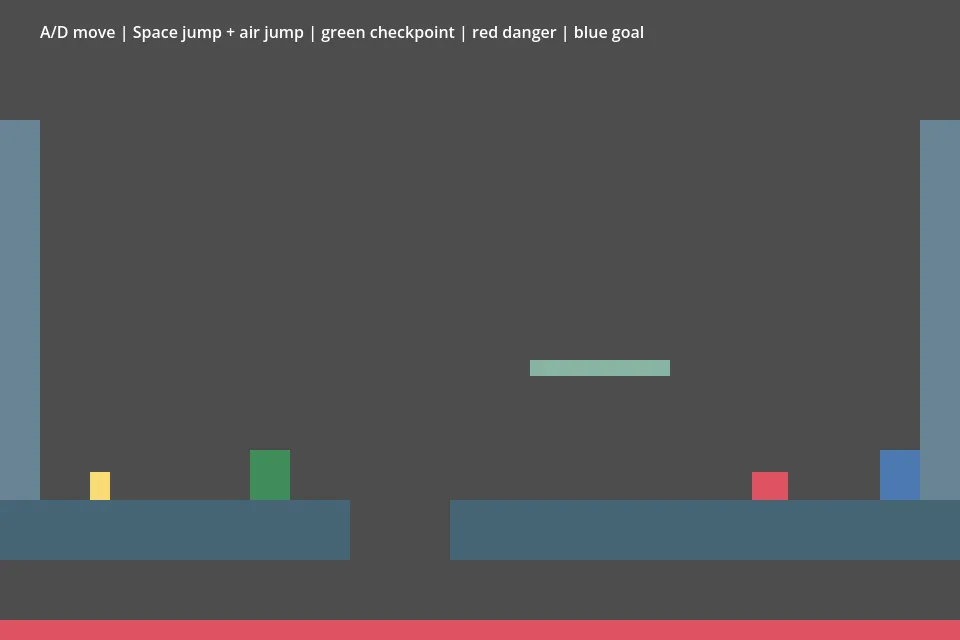
A small Godot platform game, which looked the same whether or not Claude Code used the guides.
An earlier run on the same commit and model, adding wall jumps to a platform game, went the same way: Claude Code passed all ten movement checks with or without the guides. With the router and guides named, it used the platformer guide’s suggested starting values for the wall jump; with the library installed but not named, it opened no guide at all.
Users report useful jump advice and a preference for project notes
One developer credited the guides for double jumps and buffered jumps (remembering a press just before landing), and asked for wall-jump guidance, which a contributed update added. In the project’s Reddit launch thread, another developer preferred instructions written for their own game. Keep rules your game depends on, such as save format and jump behaviour, in a project file your agent reads.
Guides, editor plugins and hosted builders do different jobs
GodotPrompter is a similar guide set for Godot only. godot-mcp-toolkit advertises an editor plugin that lets an agent edit scenes and playtest inside Godot, which helps check that a game actually plays. Hosted builders depend on a service staying online: Gambo, a builder for game code and assets, has shut down, AI IDE List reports. Downloaded guide files stay on your machine.
Agents handle routine Godot work; playtesting is still yours
Wait before adding awesome-gamedev-agent-skills to a Godot project: the guides load, but Claude Code passed every check without them on three small tasks, and on the task we compared, the guides added three to four and a half times the input for no measurable gain. These were short tasks on one model, so a longer or less familiar job may still benefit. If you try it, name the router in your prompt: Claude Code opened the testing guide unasked here, but no guide in our wall-jump test. Otherwise, start with a plain prompt, and keep the rules your game depends on in a project file. Then playtest: the studies above found that agent-made games still fall short in play.