Repo review · Tested August 7, 2026
open-seo brings the SEO suite home. The data bill follows.
open-seo is a self-hosted, open-source SEO suite for keyword research, audits, rank tracking, and agents. The app is free; live DataForSEO data is not.

SEO suites promise one subscription, one dashboard, and enough competitive intelligence to make the rest of the internet feel improperly transparent. open-seo is an open-source SEO tool that changes who owns the dashboard. The intelligence still comes from a paid provider.
open-seo gives you an MIT-licensed application, local project state, saved research, exports, and agent access, while DataForSEO supplies the live keyword, SERP, backlink, and audit data. Open source removes the software landlord here. The utility bill survives.
Tested: commit
9d19e439905a9a954ccdefe22d9270d7c389695d(v0.1.3) on August 7, 2026. Setup: the source image took 833 seconds to build on 4 vCPU and 8 GiB RAM. Workflow: two bounded US/English Related-keyword searches, followed by save, reload, database, and CSV verification. Result: 1 row on the first query, 55 on the recovery query, 3 saved after reload, matching D1 and CSV keyword sets, and $0.07072 in provider spend. Verdict: try it for intermittent research; adopt recurring operations with care.
Set up open-seo with your coding agent
Paste this prompt into Claude Code, or another coding agent that can run commands, to start the latest open-seo from GitHub with Docker Compose. You add the DataForSEO key yourself, and it asks before it starts the container.
Set up open-seo (https://github.com/every-app/open-seo) on this computer with Docker, so I can do keyword research in my own workspace. Go one step at a time.

1. Check `docker --version` and `docker compose version`. If Docker is missing, stop and ask me; do not install it yourself. Then get the latest code:
   git clone https://github.com/every-app/open-seo.git && cd open-seo && cp .env.example .env
2. Ask me whether to turn off open-seo's anonymous usage reports. If I say yes, add the line OPENSEO_TELEMETRY_DISABLED=1 to .env.
3. Stop and wait for me. I will put DATAFORSEO_API_KEY into .env myself; the value is the Base64 credential from DataForSEO's API Access page. Never ask for, read back or print it, and do not run `docker compose config`, which prints it.
4. Tell me the next step pulls ghcr.io/every-app/open-seo:latest and starts it on 127.0.0.1:3001 with no login screen, then wait for my yes. After I agree, run:
   docker compose up -d
   The first start can take a few minutes. Then run `docker compose ps` and `curl -s http://localhost:3001/api/health`. The container should be healthy and the health check should report the configuration and database status. Stop otherwise.
5. Do not run a keyword search yourself: each search spends DataForSEO credit. Tell me to open http://localhost:3001, create a project and run one Related keyword search.
6. Do not expose the port through a tunnel or reverse proxy. Report what you created or changed and what failed. Do not retry a failure more than once without asking.
An open-source SEO tool with a paid data meter
The project calls itself an open-source alternative to Semrush and Ahrefs. More precisely, it is a self-hostable SEO workbench arranged around an external data provider. A person creates projects, researches terms, saves useful records, exports them, and can expose the same workspace to an AI agent through MCP and packaged skills.
open-seo sits between DataForSEO and the next decision in your process: what to publish, monitor, compare, or fix. It competes with the workflow layer of an all-in-one suite, not with the proprietary crawlers and indexes those suites own. If an agent only needs live provider data, DataForSEO already offers its own MCP server. open-seo earns its place by adding a human interface, durable state, and an opinion about how the work should flow.
The project is also young. The public repository appeared in February 2026, and v0.1.3 shipped five months later. By our August snapshot, GitHub reported 10,818 stars, 1,243 forks, 415 commits, and 31 releases: fast growth, not yet settled operations. Roughly 93% of commits came from the lead maintainer, so most of the project’s maintenance currently depends on one person.
From keyword research to a file you can keep
We built the exact revision, started it on loopback with telemetry disabled, and created a US/English project. The preregistered Related query was open source software reviews, capped at 150 results with clickstream refinement off. It completed successfully and returned one row: the seed itself.
We retained that result, amended the plan, and ran one broader query, open source seo tools, under the same spending ceiling. open-seo returned 55 rows with volume, CPC, competition, difficulty, intent, and trend data. The table included both populated and unavailable values rather than filling gaps with invented precision.
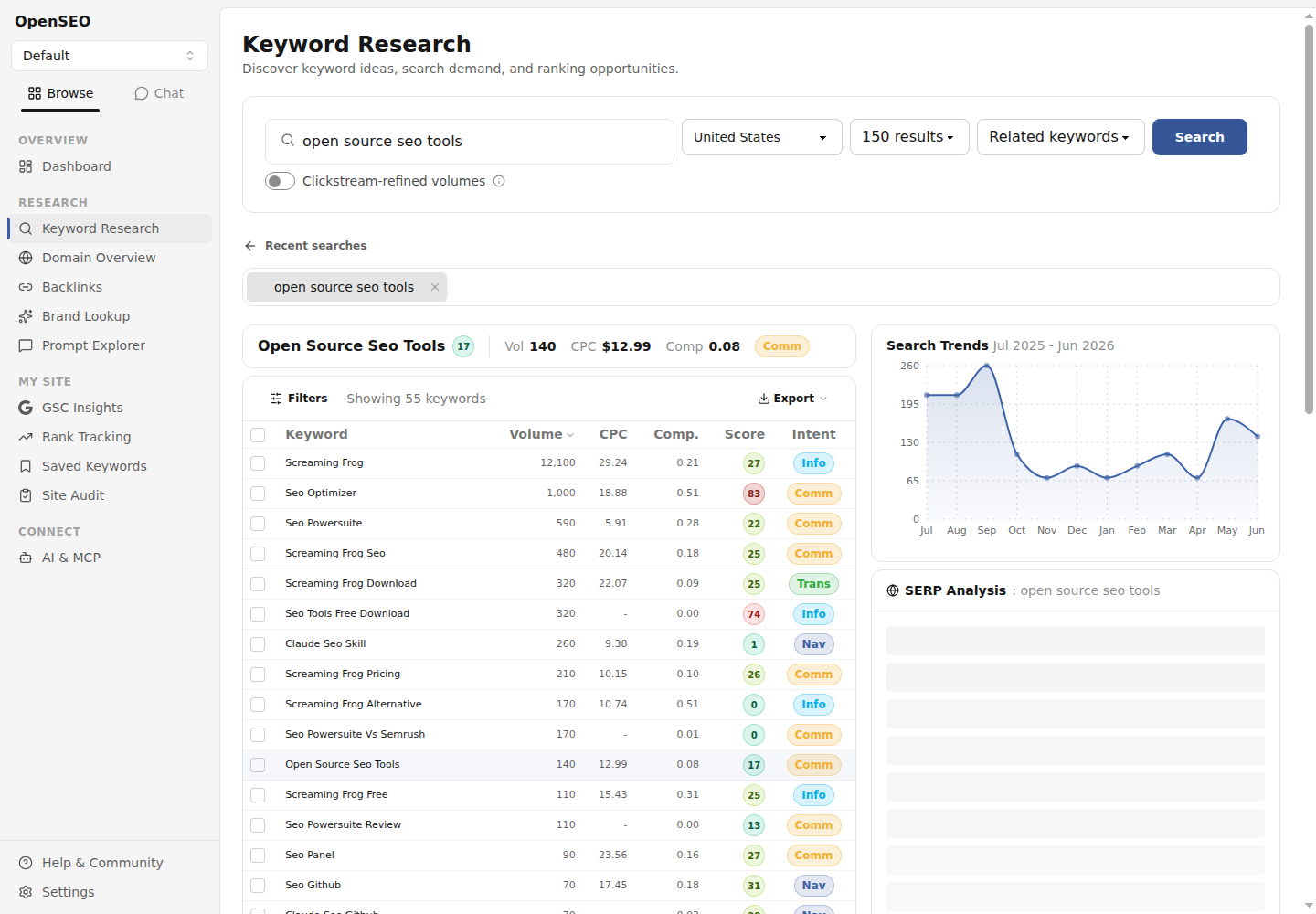
We selected screaming frog, seo optimizer, and seo powersuite. All three survived a page reload. The Saved Keywords interface, local D1 table, and independently parsed CSV contained the same three-keyword set. The two live requests reduced the dedicated provider balance by $0.07072 in total.
After preserving the primary evidence, we restarted the application with a deliberately invalid credential. open-seo identified the rejected key, explained the required encoding, and offered a retry. It did not display stale results as success.
Owning the app is not owning the index
The core workbench held together. A provider-backed query became an inspectable table, selected opportunities became durable records, and those records became a parseable file suitable for editorial planning. The error path was specific enough to act on.
A paid request can succeed technically and still return nothing useful beyond the phrase you supplied. One recovery query proves the workflow, not broad result quality across topics, markets, or languages. We checked internal consistency, not whether every metric agrees with a second paid provider.
Ownership is real. The source build took nearly 14 minutes on the test VM, container startup performs another application build, and the default Compose configuration points at a mutable latest image unless the operator pins it. The documented local_noauth mode belongs on loopback or behind an authenticated private boundary. Core research requires DataForSEO; optional Google, OpenRouter, and telemetry features add more network edges.
Upstream activity cuts both ways. Recent releases fixed incorrect organic positions and broken deployment paths, while open reports describe missed scheduled rank checks and deployment friction. Those reports are not our reproductions, but they reinforce the case for testing the exact workflows your team will depend on.
Who should put open-seo on the desk
open-seo fits when you already accept DataForSEO pricing, want intermittent research in a self-hosted workspace, and value sharing saved state between a person and an agent. Usage billing may fit occasional work better than a large monthly suite, although DataForSEO currently requires a $50 minimum payment.
It is the wrong fit if you expect free live data, an independent index, a predictable flat bill for heavy use, or a turnkey service. Choose Google Search Console for first-party performance data on sites you own, a specialist such as Screaming Frog for technical crawling, or direct provider APIs when the workspace adds no value. If the deciding job is a connected Search Console view plus a simple site crawl, crawlseo is the more focused self-hosted comparison. Treat scheduled tracking, audits, and other business-critical modules as unverified here.
Own the desk, rent the data
Try open-seo for intermittent, hands-on research. It turned metered provider data into a coherent workspace, and the workflow we tested preserved its records from table to CSV.
Adopt it with care for recurring or team-critical operations. The product is five months old, exact deployment takes deliberate pinning, and most maintenance currently rests with one person. A successful narrow request can also produce an empty meeting that ends exactly on time.
The next meaningful retest is scheduled rank tracking plus MCP against a newer pinned release, especially after upstream reports and maintainer concentration change. Until then, open-seo is a useful way to own the desk. The web index still arrives with a meter attached.